Browse All Stories

Parkinson’s Podcast with the Phinney Foundation
In this podcast, Chris Krueger interviews three people to discuss riding gravel with Parkinson’t Disease including a physical therapist who works with people who have Parkinson’s, a cyclist who rides with Parkinson’s and the Executive Director of Dirty Freehub. The podcast includes discussions about route selection and strategies for riding with Parkinson’s. The Phinney Foundation […]

I’m Back On Track
Dirty Freehub’s Gravel Champ Jim Sipe is featured in this magazine (which has a distribution of 50,000 to doctor’s offices across the US), to inspire other Type 1 Diabetics to try gravel cycling. (Just scroll down to find the article) Jim also talks about working with Dirty Freehub.

Gravel Cycling Website Goes Analog
In today’s hyper online world, a website begetting a book — and a series of them, no less — might read like putting the cart before the horse. Yet, delightfully, the popularity of Dirty Freehub — the result of a married duo’s passion for route scouting, mapping and storytelling — has inspired this retro-tech arc.

Update: End of the Trail? Bend Trails Goes Offline
The founders of one of Central Oregon’s richest resources for mountain biking trail intelligence are bookending their decade-long community give-back with a plea: Keep Bend Trails alive by buying it.
Jennifer Ware-Kempcke | The Artist
In this episode of the DF Connection podcast, Jennifer Ware-Kempcke discusses her artistic journey and her collaboration with Dirty Freehub to create the cover art for the Deschutes River Basin gravel cycling guidebook.
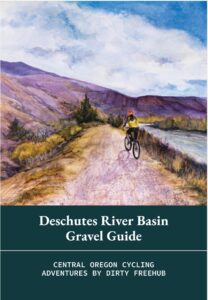 As a dedicated watercolorist and teacher, Jennifer explains how her work is deeply inspired by the natural landscapes and shifting light of Central Oregon. She details her preference for versatile techniques, ranging from photorealism to abstract styles, while emphasizing her constant drive to experiment with new mediums like pastels and oils.
The conversation explores the technical challenges of commissioned work and the history of plein air painting, which involves capturing scenes directly outdoors.
Jennifer also highlights her commitment to the local art community by teaching classes and exhibiting her pieces in various regional galleries. Ultimately, the source illustrates the powerful connection between outdoor recreation, environmental storytelling, and visual art.
This podcast is brought to you in part by Visit Central Oregon and in part by kind donations from our cycling community. You can find all of our podcasts on your favorite podcast platform under DF Connection.
Geological Secrets: The Water & Lava Route
The Water and Lava route is Dirty Freehub’s most popular gravel bike ride, so we figured it was time to dig a little deeper — literally. This route, located in Bend, Oregon, is a living geology lesson on two wheels. 🌋🚴♂️ So let’s slow it down, zoom out, and explore what’s really going on beneath the tires with geologist Dr. Kim Ely.

The Importance of Land Trusts
We all have heard the term “land trust”. But, do you really know what a land trust does? Why land trusts may be the most important element to recreation and wildlife habitat conservation moving forward? In this podcast, we speak with Amanda Martino, the Conservation Director, with the Blue Mountain Land Trust. {add Spotify} Land […]

Puncture Vines (Goatheads)
What Are Goatheads? Goatheads—also called puncture vine (Tribulus terrestris)—are a low-growing plant that produces hard, woody, spiky seedpods. Those seedpods are notorious for puncturing bike tires and ruining rides, especially if you’re not tubeless. They’re common across many regions of the U.S. and Mexico, especially in hot, dry areas with disturbed soil. Why Cyclists Hate […]

Google Ads Campaign Manager (Volunteer)
Overview Dirty Freehub is seeking a Google Ads Campaign Manager to manage and monitor our Google Ads campaign. Google donates $1,000 per month in free Google Ads advertising to Dirty Freehub, and we’re looking for a volunteer to help ensure these funds are used effectively to support our mission. This role is fully remote. Time […]

Work Crew Coordinator (Volunteer) — Dirty Roads Team
Overview Dirty Freehub is seeking a Work Crew Coordinator to support our Dirty Roads Team in Oregon. This volunteer role helps organize community-led road and trail maintenance efforts—especially critical this year due to catastrophic rains and flooding in December 2025, which likely caused widespread landslides, washouts, and tree fall across many of our routes. This […]
Shaniko – past and present
The story of Shaniko – past and present. In this 7-minute video, learn how residents are re-capturing and preserving Shanikos’ past.
“In its heyday, Shaniko was a bustling hub of commerce. The Columbia Southern Railroad terminated here, bringing wool buyers from all over the globe. At its peak, Shaniko set a one-day sales record of five million dollars — worth $176 million today.”
The Entire History of Yellowstone National Park
From Wild America comes the story of Yellowstone, a place where geology, history, and politics intertwine in an epic narrative of discovery and conservation. A place that reminds us that, in a world defined by constant change, some things are valuable enough to be preserved exactly as they are.
Discover Priday Ranch – why it is special and important!
In this two-minute video, learn about one of the Deschutes Land Trust’s newest conservation projects: the 4,500-acre Priday Ranch. The property features three creeks, outstanding wildlife habitat, hills of native bunchgrasses, and canyon walls that are home to golden eagles.

GravelPlex Overview
What is GravelPlex? GravelPlex is a new type of digital map developed by Dirty Freehub that will be available on the Avenza platform. It’s designed specifically for gravel cyclists who want to explore roads with low vehicle traffic and mixed surfaces—paved, gravel, and primitive dirt roads. Unlike mountain bike trail maps, which focus on singletrack […]

Legend of Wy’east
Long before these peaks were stone and snow, they were people. Two brothers, proud and strong. Wy’east, the fiery one—quick to laugh, but quicker to rise in anger. Pahto, quieter, heavier in thought, but no less fierce. And between them lived a maiden, Loowit, graceful as moonlight on still water. Their father was the Great […]

Gravel Champ Rick Marshall: Podcast on Riding Across the US
Dial in on this podcast that features our Gravel Champ, Rick Marshall as he talks about riding across the United States. Rick is an active duty Army veterans who uses gravel cycling to combat PTSD.

Impact Report 2025
Hot off the press, Dirty Freehub’s Impact Report for this year. Our calendar year starts Oct 1st!

Heading outside: gravel routes
More cloudy days this weekend. Fingers crossed the sun breaks through once or twice. Sunday looks like the day to get out, with temperatures rising into the 60s. Local trails may be waterlogged due to rains this week, but expect our sandy soils to soak things up come the weekend. After some possible rain Thursday, […]

Three Things Nobody Tells You About Cycling the Aufderheidi
There are three things no one tells you about cycling the Aufderheide: 1. the first 30 miles are straight uphill; 2. the second 30 miles are straight downhill; and 3. it ends at the magical Westfir Lodge.

Halloween Haunts: Dirty Freehub Spooky Gravel Routes
This Halloween, swap cobwebs and jack-o-lanterns for dust, gravel, and ghost towns. At Dirty Freehub we’ve curated a spooktacular lineup of gravel rides from our “Ghosts” collection. Each route blends history, adventure, and just the right amount of spectral energy.
A Sawtooth Celebration

Dirty Freehub Inducts MS Advocate David Toste into Gravel Champs Hall of Fame
Dirty Freehub is proud to announce the induction of David Toste of West Linn, Oregon into the Gravel Champs Hall of Fame, honoring his dedication to both the gravel cycling community and advocacy for those living with Multiple Sclerosis (MS). Diagnosed with Relapsing-Remitting Multiple Sclerosis in 2021, David has refused to let the disease define […]
Riding the C2C Trail: 60 Miles of Oregon Adventure
Dave Jones of Destination Oregon gives us a quick 5-minute highlight of the C2C trail.
Imagine pedaling from Corvallis all the way to the Oregon Coast—60 miles of ever-changing scenery, from city parks to rainforests, quiet small towns, and rugged forest service roads. The trail is the product of years of sweat, vision, and volunteer grit, now offering adventurers an unforgettable ride that ends with the salt air on your face.